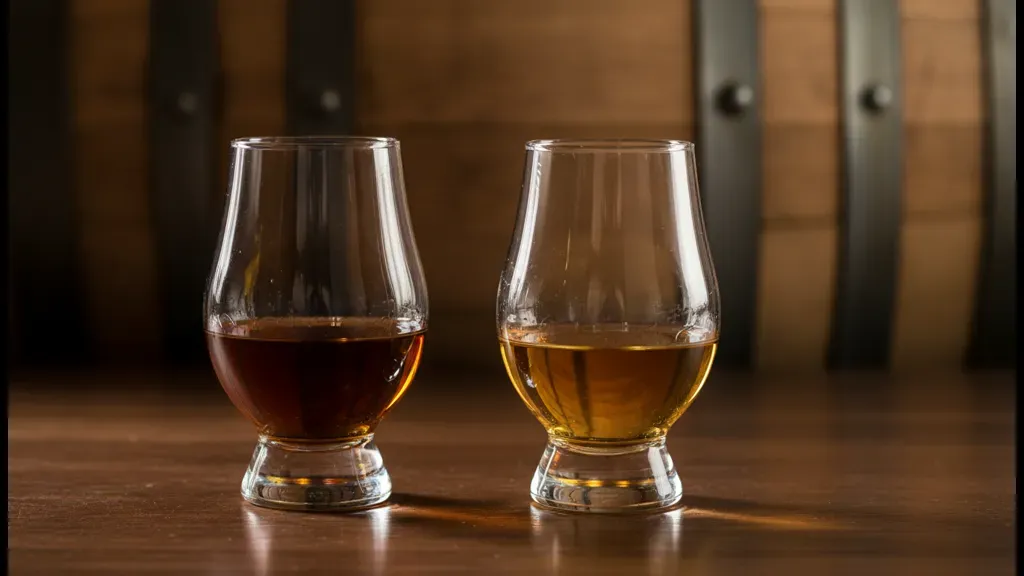
Every bourbon is a whiskey, but not every whiskey is a bourbon. That one sentence settles the broadest question, yet it barely scratches the surface. The real story involves federal law, grain recipes, barrel requirements, geographic politics, and a Prohibition-era distiller who forced Congress to draw the line between the two.
Explore Mary Dowling’s award-winning bourbon collection to taste these differences for yourself.
What Is Whiskey?
Whiskey is a broad family of distilled spirits made from fermented grain and aged in wooden barrels. The name comes from the Gaelic “uisce beatha,” meaning “water of life.” Every whiskey-producing country has developed its own traditions, regulations, and flavor signatures.
Scotch whisky uses malted barley and ages in used oak casks across Scotland. Irish whiskey is typically triple-distilled for a smoother character. Japanese whisky draws from Scottish techniques but adds its own precision. Canadian whisky tends toward lighter, blended styles. American whiskey includes bourbon, rye, Tennessee whiskey, corn whiskey, and more.
The common thread across all of these: grain is mashed, fermented, distilled, and aged in wood. Everything after that, from the type of grain to the kind of barrel to the climate where it matures, creates the specific identity of each style.
What Makes Bourbon Different from Other Whiskeys?
Bourbon is one of the most tightly regulated whiskey styles in the world. To carry the name “bourbon,” a whiskey must meet every one of these federal standards, set by the U.S. Alcohol and Tobacco Tax and Trade Bureau (TTB):
- Made in the United States. While roughly 95% of bourbon production happens in Kentucky, it can legally be distilled in any state.
- Mash bill of at least 51% corn. This minimum corn content is what gives bourbon its signature sweetness. The remaining grains (rye, wheat, or malted barley) shape the flavor profile.
- Aged in new, charred oak barrels. This is the rule that separates bourbon from nearly every other whiskey style. Scotch, Irish, and most other whiskeys reuse barrels. Bourbon requires a fresh barrel every time.
- Distilled to no more than 160 proof (80% ABV).
- Entered into the barrel at no more than 125 proof (62.5% ABV).
- Bottled at a minimum of 80 proof (40% ABV).
- No added coloring, flavoring, or other additives. What you taste comes only from the grain and the barrel.
These are not optional guidelines. They are federal law. Miss one requirement and the spirit cannot be labeled bourbon. For a deeper breakdown, see our complete guide to bourbon.
Bourbon vs Whiskey: A Side-by-Side Comparison
| Category | Bourbon | Whiskey (General) |
|---|---|---|
| Country of Origin | United States only | Produced worldwide |
| Primary Grain | At least 51% corn | Varies (barley, rye, wheat, corn) |
| Barrel Type | New, charred American oak | Often reused or varied casks |
| Additives Allowed | None (water only) | Varies by country (some allow caramel coloring) |
| Minimum Aging | No minimum (2 years for “straight”) | Varies (3 years for scotch, no minimum for some styles) |
| Flavor Profile | Sweet: vanilla, caramel, oak | Ranges widely by style and region |
| Spelling | “Whiskey” (American convention) | “Whisky” in Scotland, Canada, Japan; “whiskey” in Ireland, USA |
The comparison table shows the key differences at a glance, but the most important distinction comes down to the barrel. Bourbon’s new charred oak requirement drives the lion’s share of its flavor: the vanilla, caramel, toffee, and toasted oak notes that bourbon drinkers love. Other whiskeys pull subtler, more varied flavors from barrels that have already given up their boldest compounds during a previous use.
How the Mash Bill Shapes Bourbon’s Flavor
The 51% corn minimum guarantees sweetness, but the remaining 49% is where distillers make their mark. Three main styles have emerged based on the secondary grain:
Wheated bourbon substitutes wheat for rye as the secondary grain. The result is a softer, rounder spirit with notes of honey, bread, and gentle vanilla. Mary Dowling Winter Wheat Bourbon is a wheated bourbon finished in toasted barrels from Kelvin Cooperage, delivering ripe cherry, roasted nuts, and golden honey at 91 proof.
High-rye bourbon uses a larger proportion of rye grain, producing bolder spice, black pepper, and a dry finish that stands up well in cocktails. Mary Dowling Tequila Barrel Finish starts as a high-rye bourbon, then ages in reposado tequila barrels for added layers of citrus, smoke, and lingering spice at 93 proof.
Traditional bourbon uses a balanced mix of corn, rye, and malted barley. This is the most common style, offering a blend of sweetness and spice that sits between the other two.
For more on how mash bills create different bourbon styles, read our guide to types of bourbon.
Order Mary Dowling bourbon online and taste the difference mash bill and barrel finishing make.
The 1964 Resolution: How Bourbon Became America’s Native Spirit
The legal distinction between bourbon and other whiskeys was not always clear. For decades, bourbon was produced both inside and outside the United States. That changed on May 4, 1964, when Congress passed a concurrent resolution declaring bourbon whiskey “a distinctive product of the United States.”
The resolution carried real weight. It meant that no whiskey produced outside the country could be labeled and sold as bourbon in the United States, just as champagne can only come from the Champagne region of France or scotch can only come from Scotland.
But here is the part most bourbon guides leave out: this law did not appear out of nowhere. It was driven, in part, by bourbon being produced in Mexico.
Mary Dowling and the Distillery That Forced the Law
Mary Dowling was the only woman running a major Kentucky distillery in the early 1900s. After her husband John died in 1903, she took sole ownership of their operations, including the Waterfill & Frazier distillery. She rebuilt it after a fire in 1904, overcame credit discrimination by helping charter a bank, and led Liberty Bond sales during World War I.
When Prohibition shut down legal distilling in 1920, Mary refused to let her bourbon die. After years of legal battles with federal authorities, including a conviction she appealed and 4,800 bottles that “mysteriously disappeared” in a government warehouse fire, Mary made a move no other distiller considered. She hired Joe L. Beam (of the Beam distilling family) to dismantle the Waterfill & Frazier distillery piece by piece and ship it across the border to Ciudad Juarez, Mexico.
There, partnering with Antonio Bermudez (who later became director of PEMEX, Mexico’s national petroleum company), she established D&W Distillery. It legally produced bourbon outside the United States for 38 years, outlasting Prohibition itself by more than three decades.
The existence of legitimate bourbon production in Mexico created a problem for the American whiskey industry. Domestic producers could not compete with a foreign operation using the same name. The 1964 Congressional resolution settled the matter permanently: bourbon, by law, could only be made in the USA.
Mary died in 1930, but the distillery she built in Juarez continued operating until 1964, the very year Congress drew the line. Today, Mary Dowling’s story stands as one of the most remarkable chapters in bourbon history. The Mother of Bourbon book by Kaveh Zamanian and Eric Goodman tells her full story.
Is Jack Daniel’s a Bourbon or a Whiskey?
Jack Daniel’s meets every legal requirement to be called bourbon: it is made in the USA, uses a mash bill with at least 51% corn, ages in new charred oak barrels, and contains no additives. However, Jack Daniel’s adds one extra step called the Lincoln County Process, which filters the whiskey through sugar maple charcoal before aging.
Because of this extra filtration, Jack Daniel’s labels itself as “Tennessee whiskey” rather than bourbon. Tennessee whiskey is legally required to use this charcoal filtering step under state law. Technically, it qualifies as bourbon under federal rules, but the brand chooses the Tennessee whiskey designation.
Jim Beam, by contrast, proudly claims the bourbon label and skips the charcoal filtering. Both are American whiskeys. Both meet bourbon requirements. The difference comes down to one extra production step and the marketing identity each brand chooses.
Discover Mary Dowling’s collection of Kentucky straight bourbon whiskeys, crafted with bold mash bills and hand-toasted barrels from Kelvin Cooperage.
How Does Bourbon Compare to Scotch and Rye?
Bourbon, scotch, and rye all fall under the whiskey umbrella, but each follows different rules and delivers a different drinking experience.
Bourbon vs scotch: Scotch must be made in Scotland from malted barley (for single malt) or a grain mixture (for blended scotch). It ages for a minimum of three years in used oak casks, often former bourbon barrels. The Scottish climate, peat-rich water, and barrel reuse create flavors that lean toward smoke, fruit, and malt rather than bourbon’s sweet vanilla and caramel. For a full breakdown, see our bourbon vs whiskey vs scotch comparison.
Bourbon vs rye: Rye whiskey follows the same federal framework as bourbon, but the mash bill must be at least 51% rye grain instead of corn. This swap produces a drier, spicier spirit with pepper and herbal notes. Rye is the traditional backbone of cocktails like the Manhattan and the Sazerac. See our detailed bourbon vs rye whiskey comparison for more.
Why Does Bourbon Taste Sweeter Than Other Whiskeys?
Three factors combine to give bourbon its distinctive sweetness:
- Corn content. The 51% minimum corn requirement makes bourbon sweeter at the grain level than rye-forward or barley-forward whiskeys. Corn converts to more fermentable sugars during mashing, and those sugars carry through distillation as sweet flavor compounds.
- New charred oak barrels. A fresh charred barrel offers maximum wood sugar extraction. The charring process caramelizes the wood’s natural sugars (hemicellulose), creating a layer of caramel and vanilla that the spirit absorbs during aging. Reused barrels, like those required for scotch, have already given up most of these sugars.
- Kentucky’s climate. Most bourbon ages in Kentucky, where hot summers push the spirit deep into the wood grain and cold winters pull it back out. This seasonal expansion and contraction accelerates flavor extraction compared to the cooler, steadier climates of Scotland or Ireland.
The combination of sweet grain, aggressive barrel char, and temperature swings is what makes bourbon taste distinctly sweeter and bolder than most other whiskey styles. For a closer look at the production process, see how bourbon is made.
Frequently Asked Questions
Is bourbon stronger than whiskey?
Not necessarily. Bourbon must be bottled at a minimum of 80 proof (40% ABV), and many expressions range from 80 to 100+ proof. Other whiskeys follow similar minimums. Cask strength bourbon can exceed 130 proof, while some scotch and rye whiskeys are bottled at comparable strengths. Proof depends on the specific product, not the category.
Can bourbon be made outside of Kentucky?
Yes. Federal law requires bourbon to be made in the United States, but no specific state. Kentucky produces roughly 95% of the world’s bourbon supply because of its limestone-filtered water, favorable climate, and deep distilling heritage, but bourbon is legally produced in states from New York to Texas.
Why is bourbon spelled “whiskey” instead of “whisky”?
American and Irish producers traditionally use the “whiskey” spelling with an “e,” while Scottish, Canadian, and Japanese producers use “whisky” without it. The difference is a convention tied to geography and tradition, not a legal requirement. Bourbon is always “whiskey.”
Is bourbon healthier than other whiskeys?
There is no meaningful health difference between bourbon and other whiskeys when consumed in moderation. All whiskeys are distilled spirits with similar calorie and alcohol content per serving. The CDC recommends limiting alcohol to two drinks or fewer per day for men and one drink or fewer per day for women.
What makes a bourbon a “straight bourbon”?
A straight bourbon has been aged for at least two years. If aged less than four years, the label must include an age statement. Straight bourbon also cannot contain any added coloring, flavoring, or other spirits. The “straight” designation tells you the bourbon meets stricter aging and purity standards. Learn more about bourbon subcategories in our wheated bourbon guide.
